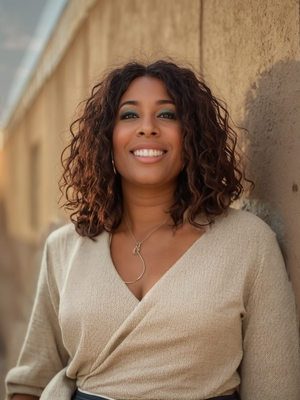
What if “that’s just who I am” is less a discovery than something you’ve become extremely well-practised at?
If
I had a penny for every person who has ever told me how confident I am, I could be hanging out on my very own private island, eating frozen grapes (as God intended) and watching Judge Judy for hours on end.
"I wish I were as confident as you, Kasey."
"You're so confident, Kase. I don't know how you do it."
"But you're so confident, Kase! What do you mean you can't do it?"
People have been admiring my confidence for years.
And so had I.
Except I wasn’t confident. Not really. What I was, was very, very good at ‘being’ confident.
There is a difference and it took me the best part of about forty years to find it.
Where it came from
I was a Black British female military brat. Air Force, to be precise. Because of my father’s work, I changed schools roughly every three years. New classroom. New children. New rules. New pecking order. New opportunity to discover that everybody else appeared to have been issued the handbook ‘How to Succeed in Life’, while I had somehow missed distribution. I arrived complete with braids, a gorgeous melanin-drenched hue that nobody else around me possessed, and, on at least one occasion, a school uniform even though the school itself did not require one, because my mother had decided she had paid good money for it, so I was wearing it anyway.
Seven schools before the age of 11, and I stood out in each and every one of them. Subtle blending-in was not on the menu. I had to embrace the situation and make the most of it or die. Those were my choices.
Underneath all of this I was shy. Very shy.
I could have adapted in dozens of ways. The invisible good girl, quietly impeccable. The high achiever, hiding behind gold stars. The cool, detached girl who rejects first so she can never be rejected.
But somewhere along the way, I chose ‘confidence’. Or perhaps confidence chose me. My mother would say: “Come on now. Be a big, strong, confident girl. You can do it.”
So, I did.
I learned what confidence looked like. And then I practised it. And then I practised it some more. I became the class clown. The one with the line, the comeback, the ability to make the room laugh.
If I was making the joke, I couldn’t be the joke.
And it worked a treat. The problem was, it was flipping exhausting. While everybody else admired this enviable characteristic of mine, I was carrying it around like a particularly glamorous refrigerator strapped to my back.
Inside, I was terrified, my inner child yelping, “Why can’t I just be me?” But the cost was too high. This version of me had friends and a family who loved her. Survival was the name of the game, and I was winning, even if it was a lie that could be discovered at any moment.
Surely today they would discover me. Today, because I burst into tears when my friend didn’t pick me for her netball team. Today, because I got a B-minus on my history essay. Today somebody would finally say:
Hang on. She isn’t confident at all.
But nobody did.
The disguise worked beautifully. So beautifully that eventually it stopped feeling like a disguise. The performance became familiar. The familiar became natural. And the natural became:
This is just who I am.
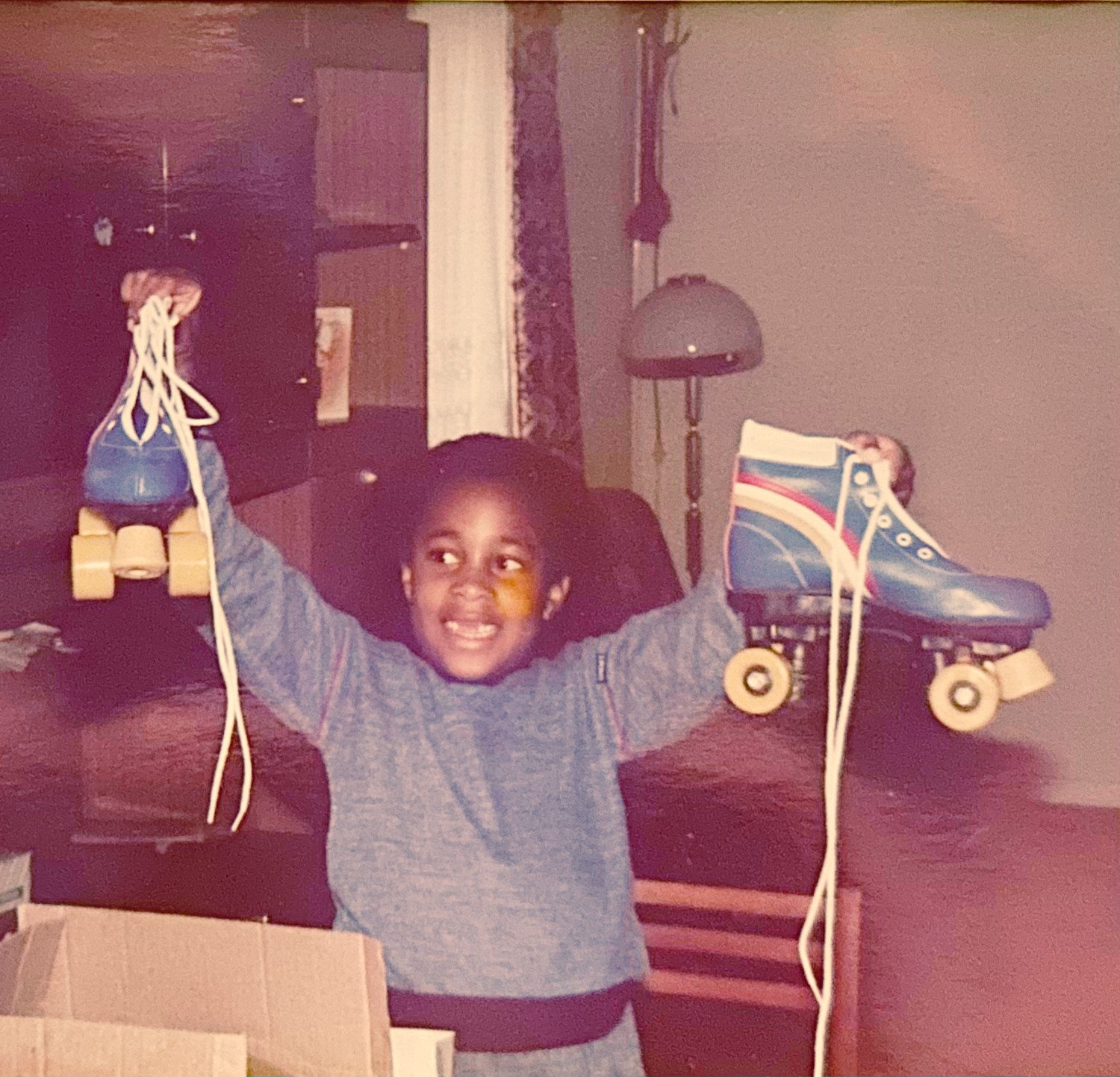
me aged 7 with my favourite birthday gift ever - my first pair of skates.
The day the glass broke
Fast-forward a few decades and there I am, in one of the granddaddies of the personal-development programme world (it shall remain nameless; if you know, you know), having the mildly horrifying experience of realising I had made quite a lot of “me” up.
I hadn’t done it maliciously, and I hadn’t done it entirely consciously. My answer to every chink in the armour of my self-esteem was to add another layer of ‘confidence’. How do I handle this rejection? Whack on some confidence: pretend I don’t need them. How do I handle this humiliation? A dollop more ‘confidence’: pretend the laughs were worth it. How do I handle this disappointment? Splash on more ‘confidence’: pretend I don’t care. You get the picture. ‘Confidence’ was my Chanel No 5, and I was dousing myself in it in such liberal amounts that stocks in the company would have been a great retirement plan. I had simply assembled a version of myself out of whatever seemed most useful at the time, and worn it for so long I had forgotten it came from the costume department.
The revelation came starkly during the programme, and it was like somebody had smashed the little red box marked SMASH GLASS IN CASE OF EXISTENTIAL EMERGENCY. I cried snotty tears. For hours, it seemed. And the relief was enormous. It was the emotional equivalent of stepping naked onto a beach into tropical sunshine after forty years in Spanx.
I walked away convinced I had discovered the ‘real me’. But here’s the part that has surprised me over time. The truth I found was not:
Aha! Here is the real Kasey.
That would simply have swapped one fixed identity for another.
The truth was:
There is more than one version of me, and I have access to them all if I want.
We become what we practise
I know it seems obvious. From tiny tots, we're told by attentive teachers and parents about the virtues of practice. But I had only ever applied this wisdom to tasks, like acting or playing tennis. I had never considered that I was practising being myself.
Honestly, it blew my mind when I got this. So I'm not fixed. It's not "just who I am". I'm blushing at my slowness.
Repeat something long enough and you stop experiencing it as a behaviour. You experience it as a fact. I’m shy. I’m the funny one. I’m bad with money. I’m independent. I hate confrontation. I don’t do things like that.
Then, rather wonderfully, we use the identity to explain the very behaviour that created it.
I never speak first because I’m shy.
How do I know I’m shy?
Because I never speak first.
Case closed. And your Myers-Briggs result confirms it.
Other people help keep the case closed too. Your family has records going back decades. Your friends will testify. Try something new and somebody laughs: “You? Since when?” And there it is. Your old self, returned to you freshly laundered and pressed on a hanger.
The ‘confident’ identity was useful. Brilliantly useful. A shy little Black girl arriving at another school full of strangers needed something, and confidence did a great job. It deserves some respect.
But strategies have a peculiar habit of outliving the circumstances that created them. You grow up. Nobody is picking netball teams anymore. And yet some ancient part of you is still standing there thinking:
Quick. Be impressive before they decide you’re not.
As a grown woman, my confidence had become more than armour. It had morphed into a wall as impenetrable as Fort Knox: nothing was getting in and nothing was getting out. What once protected me had become policy. And policy, eventually, becomes personality.
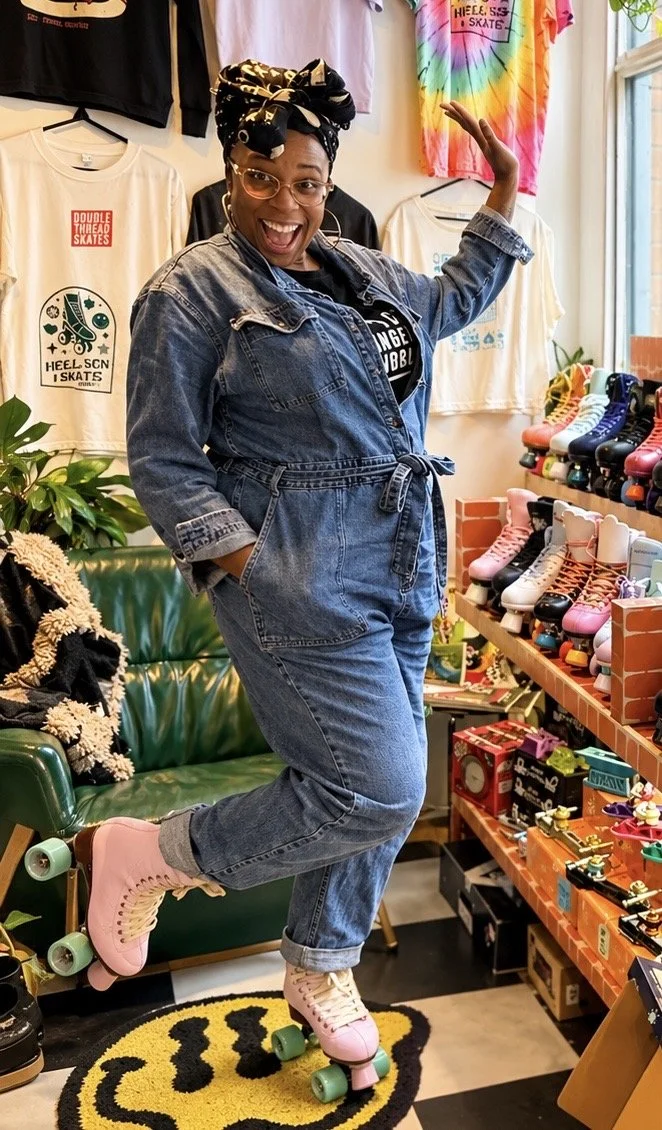
40 years later, still me, different skates!
Who haven’t you tried being yet?
There’s a seductive idea in personal development that somewhere beneath our conditioning is one pristine, authentic Self waiting to be excavated. This idea actively creates limitations in our experience. It casts you as lost from a true self you need to find, and makes any other role you play a betrayal. I challenge this and say there is no one ‘you’. There are many ‘yous’, and every one of them is available. And how you're being each of them? That's a story for another day.
“Do I contradict myself? Very well then I contradict myself, (I am large, I contain multitudes.)”
— Walt Whitman
Far from being a recipe for an identity crisis, I find the possibility this suggests mesmerising.
I think of identity less as an archaeological dig and more as a wardrobe. Moment to moment, we get to choose who shows up.
The brave one. The one who speaks. The one who receives. The one who says no. The one who has absolutely no idea what she is doing and does it anyway.
Some of these will feel strange at first. The confident girl had decades of rehearsal. The woman who asks for help, speaks first or risks looking foolish may have had three minutes. Unfamiliar does not mean false. Sometimes it simply means unpractised.
I'm currently playing with bringing more juice and vitality to my life, so the question I find most useful now isn’t “Who am I?” That one sends you backwards through the filing cabinet of everything you’ve already done, everywhere you’ve already been, an experience of life you’ve already filled countless journals with. That version of you has literally already ‘been there and done that.’
The better question is:
Who haven’t you tried being yet?
Maybe you have spent thirty years being indispensable. What happens if you experiment with being supported?
Maybe you are fiercely independent. Could you try receiving?
Maybe you are the responsible one. What happens if you become someone who occasionally says, “No idea. Not my problem”?
None of these has to be forever, and none is secretly the “real” you. It’s an experiment. A chance to play and see what else is available.
She just wasn’t all of me
The confident girl wasn’t fake.
She was real. She was resourceful. She protected me beautifully.
She just wasn’t all of me.
That’s the problem with becoming very good at being yourself. You can become so accomplished at the role that you forget there are other parts available.
These days I'm experimenting with a few new identities of my own. The woman for whom life comes easily. The woman who expects to be well paid for doing something she loves. The woman who doesn't have to exhaust herself to feel deserving. I'm not entirely convincing in all these roles yet. But then, I wasn't always convincing at being confident either.
Some feel wonderfully unfamiliar. Others, surprisingly natural. Others still, dangerous. I have already spent seven weeks of this year recovering from an unfortunate collision with a tree after strapping on roller skates for the first time in 30 years, but that hasn’t stalled my fascination. I’m discovering that just because I’ve never been someone before doesn’t mean I couldn’t be. Sure, I won’t be an Olympic figure skater, but if I keep practising, I will be Goddess-who-glides-through-parks-on-Sundays.
Perhaps being yourself isn't something you discover once and for all. Perhaps it's something you get very good at doing.
So the next time you hear yourself say, “That’s just who I am,” leave a little gap after it. Smile wryly to yourself.
You already know who you have been.
The more interesting question is who you haven’t tried being yet.
See the unseen.
Kasey xx
✦ ✹ ▶︎ ♡
P.S. This is often what shows up in an Akashic reading: the version of you that's been answering the door for years, and the ones you haven't met yet. If you're curious who else is in there, The Reading is a good place to start.